Showing posts with label Worldbuilding. Show all posts

Saturday, June 13, 2015

Worldbuilding: Bakker vs. Harrison

Wm. Timlin - The Seven Sisters

In my ongoing exploration of worldbuilding, I've gotten a great deal of inspiration from the observations of writers like Harrison, Le Guin, and Moorcock. Harrison's essays in particular helped me to put voice to my concerns about the worldbuilding obsession, my attempt to understand how it operates, and what purpose it serves. Yet, I've found relatively few writers able to write eloquently on worldbuilding's behalf, which is unfortunate, because it makes the issue feel one-sided. Of course, if it is as Harrison says, and the worldbuilding urge comes out of a desire for control, simplification, rote memorization, and authority, then it would make sense that individuals who are on the side of worldbuilding would not tend to be theorists, questioners, and underminers, searching for reasons.

I had heard that author R. Scott Bakker's response to Harrison (in this interview) was precisely the well-constructed, pro-worldbuilding manifesto I had been looking for--but unfortunately, far from presenting his own theory of the utility and purpose of worldbuilding, the response quickly devolves into a disappointing 'us vs. them' distraction, the tired old narrative of the Average Joe tilting at Ivory Towers, attacking Harrison's person and motives without ever presenting a clear refutation of his views.

Tuesday, December 18, 2012

Worldbuilding -- Part III: What Fiction Does Well

Last time, we talked about the unfortunate habits of some authors, when it comes to worldbuilding. Now let's talk about why such perfectionism can make it very difficult to write good fiction.

While reading Bernard Knox's fascinating introduction to the Fagles translation of the Oedipus plays, I came across the following quote:

“If through no fault of his own the hero is crushed by a bulldozer in Act II, we are not impressed. Even though life is often like this—the absconding cashier on his way to Nicaragua is killed in a collision at the airport, the prominent statesman dies of a stroke in the midst of the negotiations he has spent years to bring about, the young lovers are drowned in a boating accident the day before their marriage—such events, the warp and woof of everyday life, seem irrelevant, meaningless . . . it is the function of great art to purge and give meaning to human suffering, and so we expect that if the hero is indeed crushed by a bulldozer in Act II there will be some reason for it, and not just some reason but a good one, one which makes sense in terms of the hero’s personality and action. In fact, we expect to be shown that he is in some way responsible for what happens to him.”

A quote which quite aptly sums up much of what I think is wrong with the modern realism movement, and particularly, the motivations behind 'gritty' fantasy.

Tuesday, December 11, 2012

Worldbuilding and the Origin of Fandom -- Part II: The Authors

In Part I on worldbuilding, we talked about the fans, now here's my take on the author's end of things.

Tolkien is often cited as the father of worldbuilding, and though he was hardly the first to develop an invented world in which to set fantastical stories, he did take the practice to new heights of complexity. Since then, many authors have followed in his footsteps, copying his length and complexity despite the fact that neither length nor complexity are desirable traits, in and of themselves. A good short story is not improved simply by the addition of more pages, nor, when we discover a scientific principle, do we tend to represent it in its most complex form--quite the opposite: art and science both benefit from elegance and focus. As Einstein said, a scientist begins to expect the world to be beautifully elegant, such that it is often considered a good sign for a theory if it is able to represent an idea fully with the interaction of a few simple variables.

Wednesday, October 17, 2012

Worldbuilding and the Origin of Fandom -- Part I: The Fans

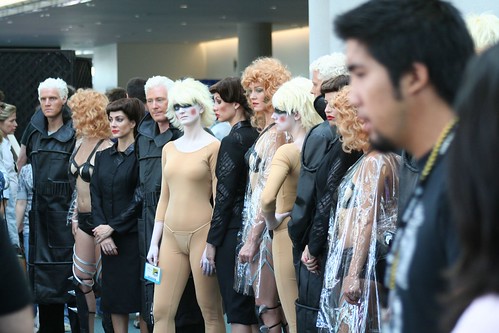
Blade Runner Cosplayers
This post originally appeared in 2012, but disappeared due to a glitch.

Some years ago, during the heyday of the Harry Potter craze, there was an interview with Rowling going around the internet where she revealed that the snake Harry freed from the zoo in the first book was actually Nagini, the bad guy's pet snake from the later books. Fans went crazy over it: here was yet more evidence of the intense amount of planning that went into Rowling's series, sure proof of the complexity and depth of her books.

Yet all I could think was that this was a meaningless detail. The whole thing turned out to be a hoax--but even if it had been true, why would it matter? Would it have added anything to Harry as a character, or to the villain? Would it have added meaning or direction to the plot? If Rowling revealed that Harry wore the same underwear the first night of class his second year as he did the first night his third year, that would technically be a connection within her world, but it still doesn't mean anything.